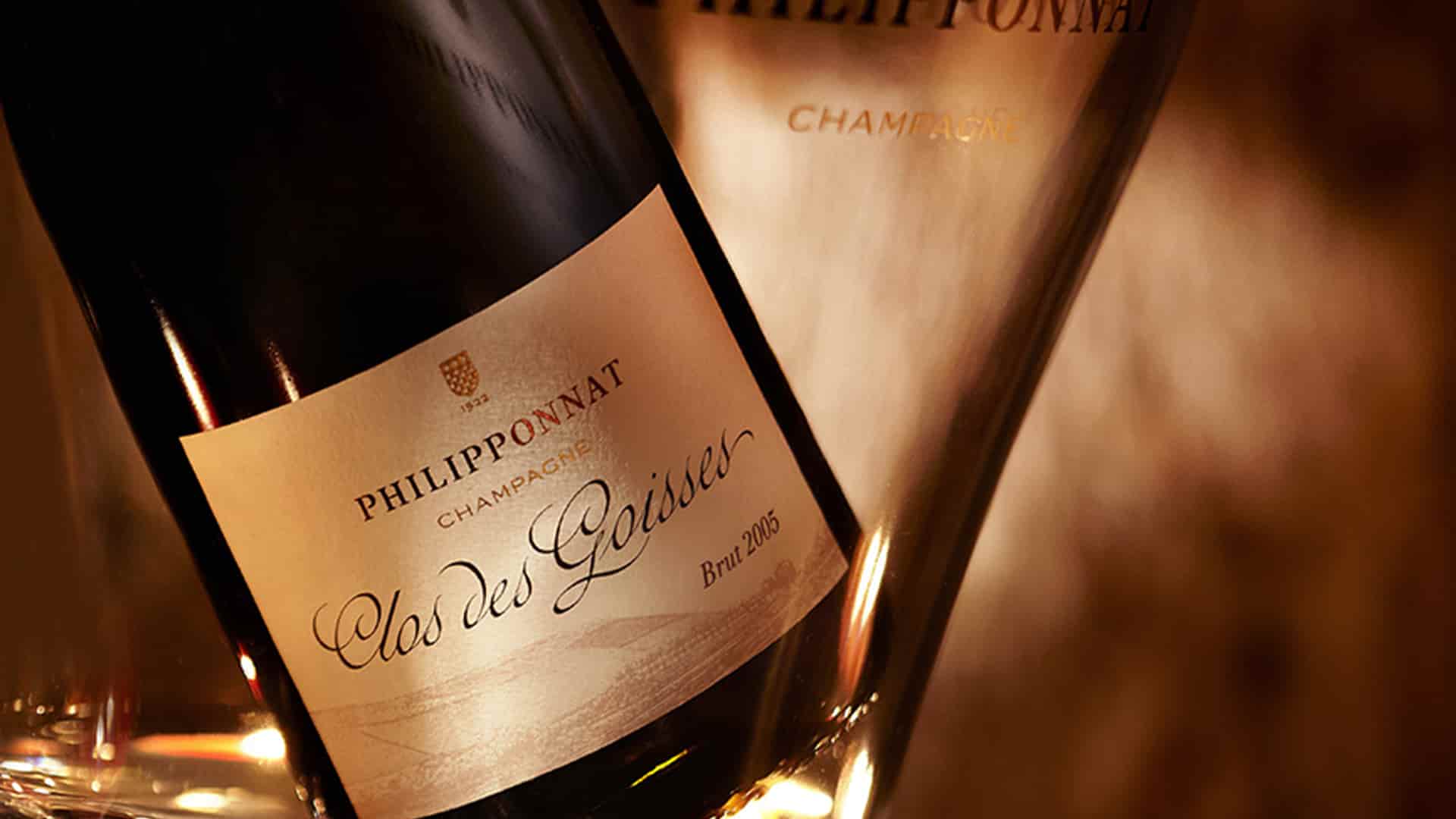
Among serious Champagne collectors, Philipponnat occupies a unique position. It is not as globally famous as Krug, Dom Pérignon or Bollinger, yet many critics and sommeliers regard its flagship wine, Clos des Goisses, as one of the greatest wines produced anywhere in Champagne. The house combines deep history, family continuity, terroir-driven winemaking and unusually ageworthy wines. Today it is often considered one of the strongest quality-to-prestige propositions among the major Champagne houses. For more info, see detailed visit report here.
History
The Philipponnat family has been established in Champagne since 1522, making it one of the oldest continuously active wine families in the region. The family were growers, merchants and civic leaders in the village of Aÿ, one of Champagne’s historic grand cru centers. Unlike many famous houses that have become highly corporate, Philipponnat remains strongly identified with its founding family. The house is today part of the Lanson-BCC group, but it is still led by Charles Philipponnat, and his son Francois Philipponnat (export director). Critics frequently cite this continuity as a key reason the house has retained its distinctive identity.
The defining moment in the estate’s history came in 1935 when Pierre Philipponnat purchased Clos des Goisses, a spectacular south-facing vineyard in Mareuil-sur-Aÿ. At a time when Champagne was almost entirely about blending, he took the radical decision to bottle a single-vineyard Champagne. Many historians consider Clos des Goisses the first truly important modern “single-site” prestige Champagne.
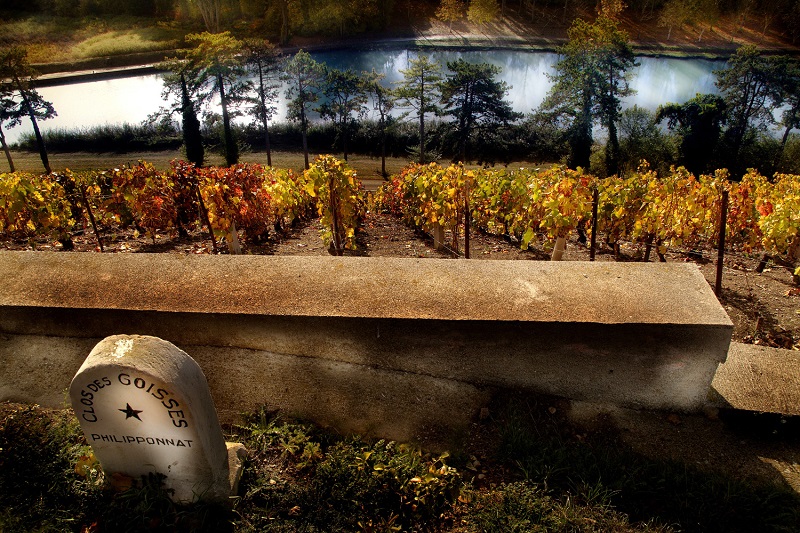
The Clos de Goisses Vineyard above the Marne canale
Clos des Goisses
For readers more familiar with Burgundy than Champagne, Clos des Goisses is best understood as Champagne’s equivalent of a grand cru monopole: a singular, highly distinctive site whose identity transcends that of the producer. Although it is important to note that Clos des Goissses is not classified as Grand Cru in Champagne because in Champagne not the vineyards, but the villages they belong to are classified. Mareuil-sur-Aÿ where Clos des Goisses is situated, is classified premier cru, while Aÿ, right next to it is classified grand cru. A French paradox… The 5.8-hectare walled Clos des Goisses vineyard occupies an extraordinarily steep south-facing slope above the river Marne, with gradients reaching 45 degrees and pure Campanian chalk lying beneath a thin layer of topsoil. Its exceptional exposition creates one of the warmest mesoclimates in Champagne, enabling a level of ripeness, concentration and consistency rarely achieved elsewhere in the region. Unlike most prestige Champagnes, which derive their greatness from blending across villages, varieties and reserve wines, Clos des Goisses is fundamentally a terroir wine, expressing a singular place with remarkable clarity. The resulting Champagnes are renowned for their combination of power and precision: intensely vinous, profoundly mineral and capable of evolving for decades. There is also remarkable consistency that we confirmed in today’s tasting. That is why, among leading critics and Champagne specialists, Clos des Goisses is widely regarded as one of the greatest vineyard sites in the region, often spoken of in the same breath as Burgundy’s most celebrated grands crus and serving as a compelling demonstration that Champagne can produce wines of site-specific character every bit as profound as the world’s finest still wines. So, what does Philipponnat Clos des Goisses taste like?
If I had to distill the essence of Clos des Goisses into a single aromatic profile, it would be: Ripe orchard fruit + citrus confit + spice + earthyness + iodine + chalk. Looking for similarities, Bollinger R.D. comes to mind.
The Tasting
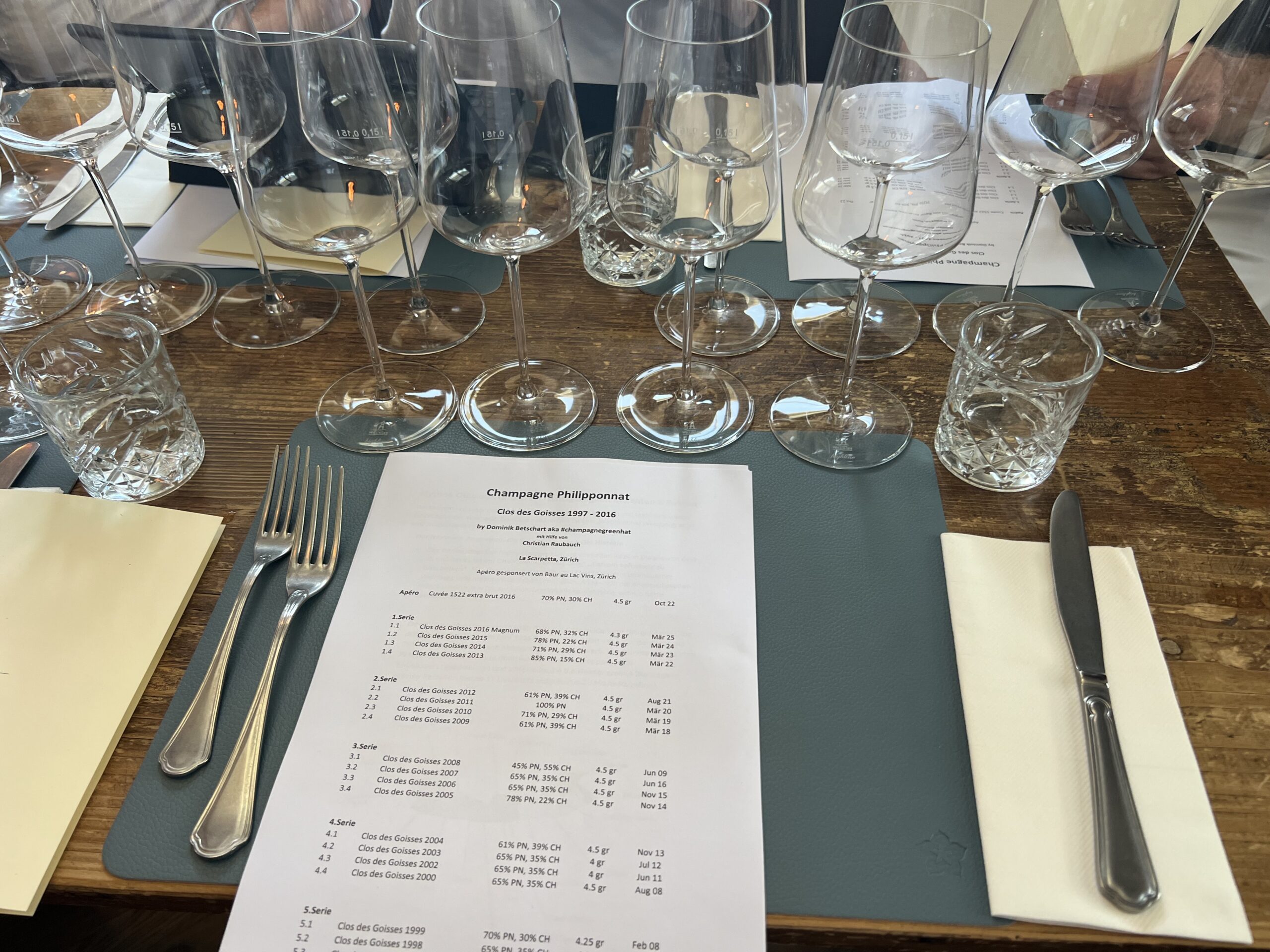
The 20 year vertical today was organized by Dominik Betschart, complemented with bottles from my private cellar. The aperitif was sponsored by Baur au Lac Vin, the official importer of Philippponnat to Switzerland. Them team of restaurant La Scarpetta provided the required frame with excellent food and service. Well known in Zurich, Dominik Betschart, co-founder of champagne merchant Les Bulles, is an expert on Champagne’s terroirs, widely respected for his knowledge and passion for authentic, grower-produced wines. In his introduction, he mentioned, that Clos des Goisses was actually the first vineyard he walked through in Champagne and therefore holds a special position in his heart.
Tasting Notes
Aperitif
2016 Philipponnat Champagne Grand Cru Cuvée 1522 Extra-Brut 92 Points
The 2016 1522 opens with a clean, if comparatively restrained bouquet of citrus oil, white stone fruit and subtle brioche tones. On the palate, it shows moderate concentration and a fine, creamy mousse, but the wine feels more composed than truly grand. There is a certain architectural correctness and freshness, yet the mid-palate lacks the depth and resonance one expects from Philipponnat’s top-tier assemblage. A well-made Champagne, but somewhat short of the depth and authority implied by its Grand Cru pedigree.
Flight 1 – Youthful Clos des Goisses
2016 Philipponnat Clos des Goisses – 97 Points
From MAG. 68/32 PN/CH, 4.3g dosage, DG 03/25. Still in an energetic, almost primary phase, the 2016 from magnum bursts with yellow orchard fruit, citrus oil and a distinctly spicy, slightly smoky register of gunflint. The mousse remains vigorous and frothy, carrying a wine of significant density and precision. A core of vibrant acidity provides real tension, preventing any sense of excess. This is a Clos des Goisses of volume and energy rather than immediate nuance, clearly built for long evolution.
2015 Philipponnat Clos des Goisses Flawed
78/22 PN/CH, 4.5g dosage, DG 03/24. A more challenging showing, marked by pronounced oxidative tones of walnut, bruised apple and dried orchard fruit. The structure appears present but the wine feels prematurely evolved. Given the consistency seen in other recent bottles, this likely represents bottle variation rather than the true character of the vintage.
2014 Philipponnat Clos des Goisses – 95 Points
71/29 PN/CH, 4.5g dosage, DG 03/23. A cooler, more linear expression. The nose is finely etched, with green apple, pear skin, white flowers and chalky minerality. The palate shows a tensile, almost austere energy, driven by bright acidity and a more restrained fruit profile. Less expansive than warmer vintages, but highly precise and deeply mineral in tone.
2013 Philipponnat Clos des Goisses Flawed
85/15 PN/CH, 4.5g dosage, DG 03/22. Unfortunately corked.
Flight 2 – Structural Diversity
2012 Philipponnat Clos des Goisses – 97 Points
61/39 PN/CH, 4.5g dosage, DG 08/21. A wine of considerable breadth and latent power. The aromatic profile combines lemon confit, baking spices, bruised orchard fruit and subtle tertiary complexity. On the palate, this is broad, layered and deeply concentrated, with a controlled oxidative edge that adds complexity rather than fatigue. The wine is structured around a dense, almost muscular core, yet remains lifted by a firm acidic spine. One of the most complete and age worthy wines of the flight. 97-98
2011 Philipponnat Clos des Goisses – 95 Points
100/0 PN/CH, 4.5g dosage, DG 03/20. A strikingly atypical vintage composed entirely of Pinot Noir. Aromatically restrained yet highly focused, with notes of citrus peel, flint and delicate red orchard fruit. The palate is unusually fine-boned for Goisses, almost filigreed, with a chiseled, linear architecture. There is a ballerina-like lightness to its structure, but still the unmistakable chalk-derived tension of the site. A technical and stylistic triumph in a difficult year.
2010 Philipponnat Clos des Goisses – 96 Points
71/29 PN/CH, 4.5g dosage, DG 03/19. A model of classical balance. White peach, linden blossom and citrus oil define a nose of quiet elegance. The palate is composed and harmonious, with a refined mousse and well-integrated acidity. Now entering an optimal early plateau, it shows both precision and subtle depth, without the extremes of richer or cooler vintages.
2009 Philipponnat Clos des Goisses – 96 Points
61/39 PN/CH, 4.5g dosage, DG 03/18. Riper and more solar in expression, with baked apple, citrus peel and subtle matchstick reduction. The structure remains intact, with sufficient acidity to support the vintage’s generosity. Compared to 2010 and 2011, this is broader and more overtly fruit-driven, yet still maintains composure. A satisfying contrast within a trio of stylistically distinct vintages.
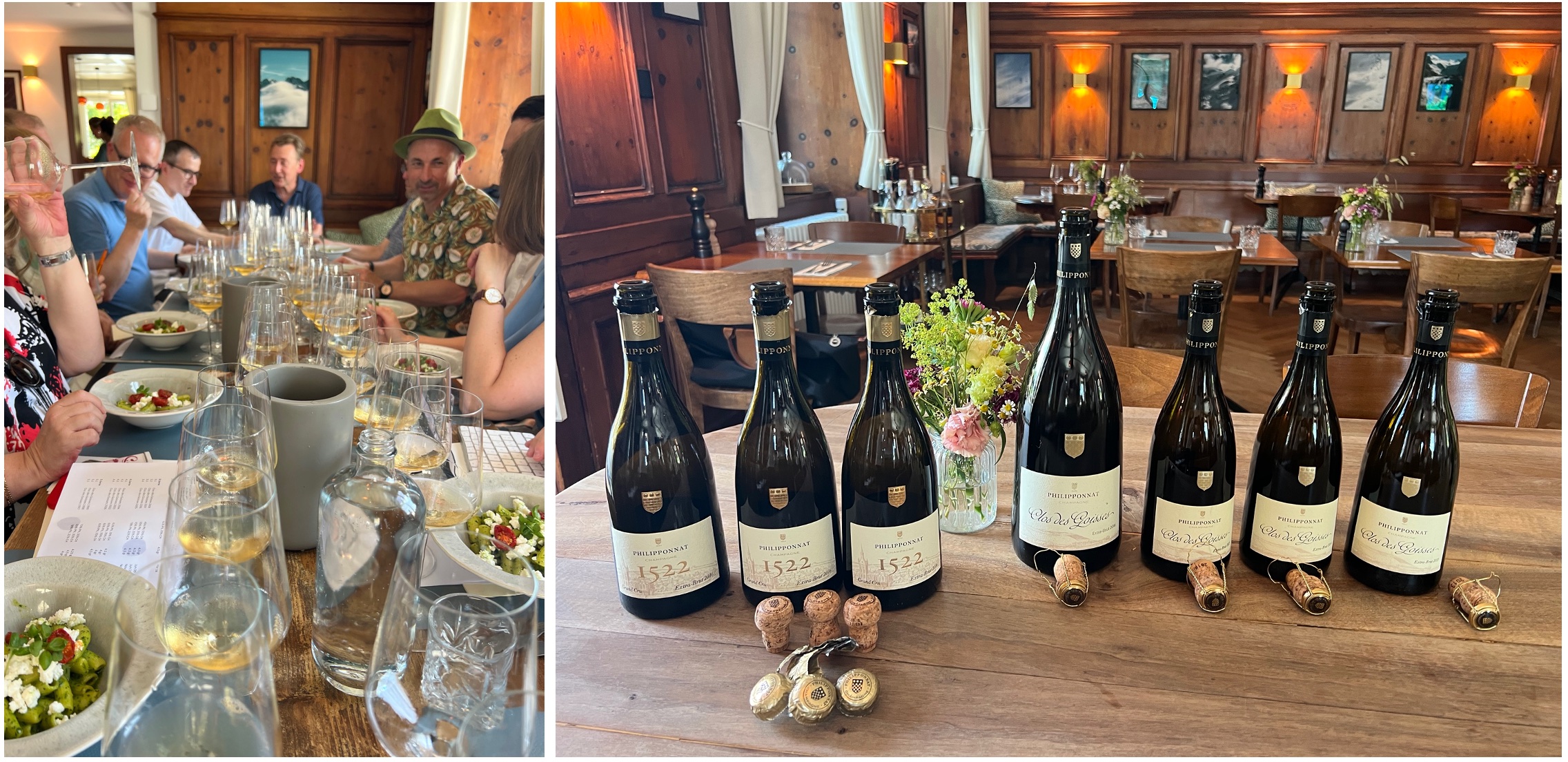
Restaurant La Scarpetta at Zurich Balgrist provided a perfect setting for this event
Flight 3 – Emerging Peak
2008 Philipponnat Clos des Goisses – 97 Points
45/55 PN/CH, 4.5g dosage, DG 03/18. A benchmark vintage and the only Clos des Goisses in this 20-year line up where Chardonnay is the dominant grape. Highly defined aromas of citrus zest, elderflower and crushed chalk unfold with remarkable precision. The palate is electric, driven by razor-sharp acidity and a mineral core. Despite its intensity, the wine is never hard; instead, it is all about vertical tension and crystalline purity. A profoundly structured Clos des Goisses with exceptional ageing potential. 97-98
2007 Philipponnat Clos des Goisses – 97 Points
65/35 PN/CH, 4.5g dosage, DG 06/16. Elegant and highly detailed, showing white flowers, citrus oil and wet stone minerality. The structure is fine-grained and linear, recalling the filigree nature of 2011 but with greater aromatic complexity and palate presence. A wine of quiet intensity and remarkable precision, clearly built on finesse rather than sheer power. Together with the 1997, 2003 one of the surprise stars in the line-up, punching above their perceived vintage quality.
2006 Philipponnat Clos des Goisses – 95 Points
45/55 PN/CH, 4.5g dosage, DG 11/15. A slightly warmer, more evolved profile, with mirabelle plum, toasted bread and earthy undertones. The palate shows more immediate generosity than the cooler vintages, yet retains a core of freshness that prevents excess. A successful, if less defining, expression of the site.
2005 Philipponnat Clos des Goisses – 92 Points
78/22 PN/CH, 4.5g dosage, DG 11/14. Rich and broad-shouldered, with yellow fruit, spice, baked apple and toasted nut character. The structure is substantial but somewhat weighted, with acidity playing a more supportive than driving role. A full-bodied Champagne by any measure, though lacking the tension and precision of the greatest vintages in the lineup.
Flight 4 – Mature Benchmark Vintages
2004 Philipponnat Clos des Goisses – 99 Points
61/39 PN/CH, 4.5g dosage, DG 11/13. A monumental showing. The wine combines crystalline precision with remarkable energy: pear, linden blossom, white flowers and intense chalk dust minerality. The palate is tightly coiled, electric and almost architectural in its tension. Acidity is vibrant yet perfectly integrated, giving the wine a sense of perpetual motion. A reference-point vintage of Clos des Goisses at its most complete and vertically expressive.
2003 Philipponnat Clos des Goisses – 98 Points
65/35 PN/CH, 4g dosage, DG 07/12. A profound surprise from a notoriously hot vintage. Aromas of apricot, quince, baked citrus and subtle sweet spice unfold into a deeply layered palate. Despite the solar character of the year, the wine retains prominent freshness, with a core of acidity that lifts the richness. Remarkably, it balances generosity and tension in a way that is unexpected for this hot vintage.
2002 Philipponnat Clos des Goisses – 98 Points
65/35 PN/CH, 4g dosage, DG 06/11. A more classically framed expression, with yellow fruit, citrus oil, earthy nuances and subtle mushroom tones from early evolution. The structure is broad and complete, with excellent depth, though in this lineup it is upstaged by the exotic 2003 and the ultra-precise 2004. A superb trio, grand-vintage expression of Clos des Goisses.
2000 Philipponnat Clos des Goisses – 93 Points
65/35 PN/CH, 4g dosage, DG 06/11. Clearly more evolved, showing tertiary notes of brioche, almond, bruised apple and lactic nuances. The structure has softened, and while there is still pleasant complexity, the wine lacks the depth and energy required for further ageing. Drink-up.
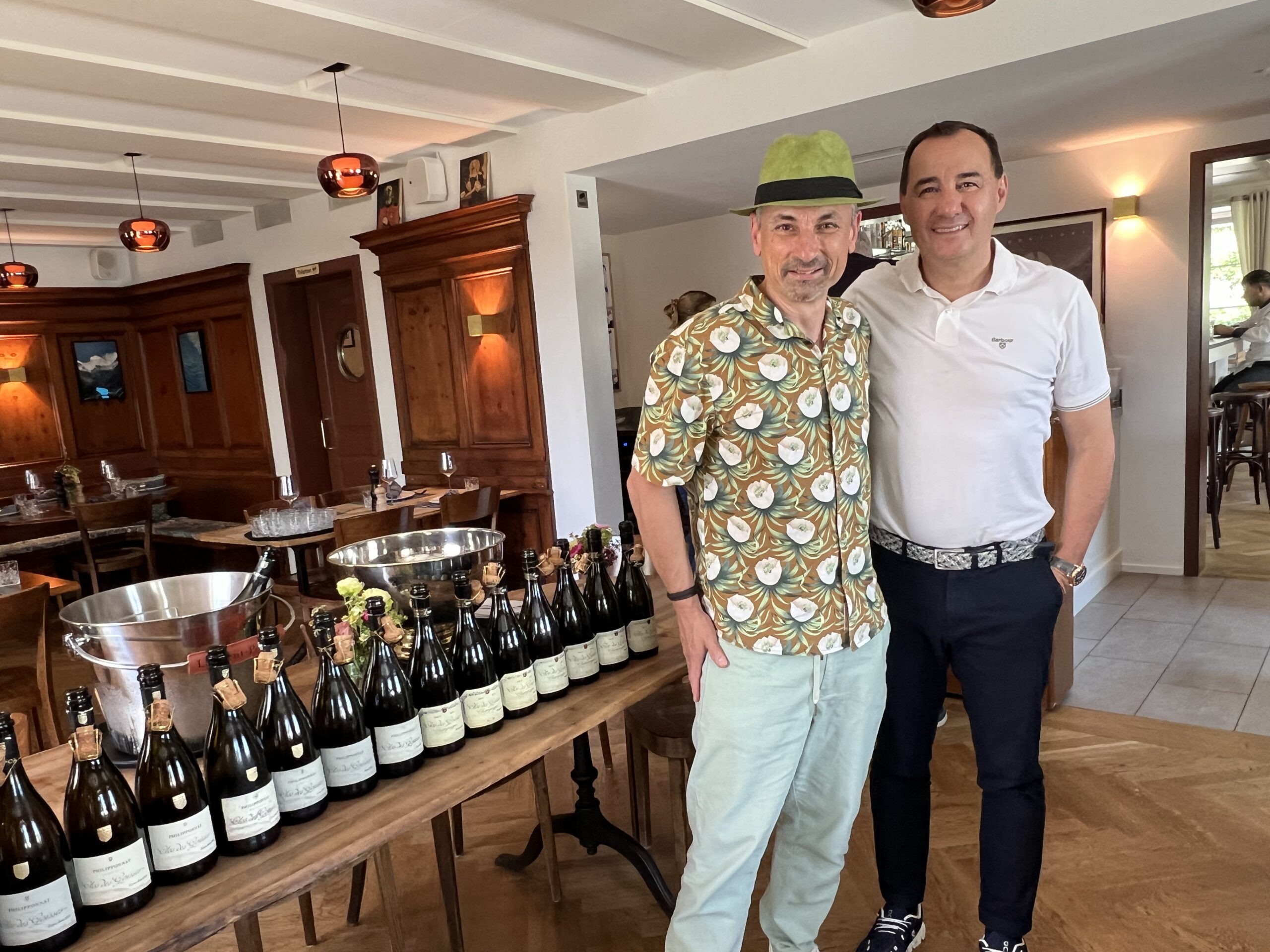
Dominic Betschart of Greenhat-events with the author
Flight 5 – Late-Vintage Perspectives
1999 Philipponnat Clos des Goisses – 98 Points
70/30 PN/CH, 4.25g dosage, DG 02/18. Remarkably youthful for its age. Aromatically vibrant with apricot, citrus oil, spice and subtle floral tones. The palate retains impressive freshness and definition, with a vibrant acidic core that preserves energy and lift. A triumphal showing at close to 30 years of age.
1998 Philipponnat Clos des Goisses – 92 Points
65/35 PN/CH, 4.5g dosage, DG 02/08. Darker in color and clearly more evolved, with tangerine, mushroom, walnut, earthy notes and spice. The structure feels more diffuse, with less supporting acidity. A competent mature Champagne but lacking the vitality seen in the strongest older vintages.
1997 Philipponnat Clos des Goisses – 97 Points
78/22 PN/CH, 4g dosage, DG 10/06. Highly unusual and striking. A strong reductive character dominates, recalling the flinty, almost Burgundian reduction of top PYCM or Coche white. Beneath this lies a fresh and energetic core, though the style will not be universally appealing. Distinctive, unconventional, and fascinating. Fans of reductive Burgs loved it, others thought it was too different to what a CdG usually is. Could it be just this bottle or the entire vintage? A mistery to be left unsolved for now.
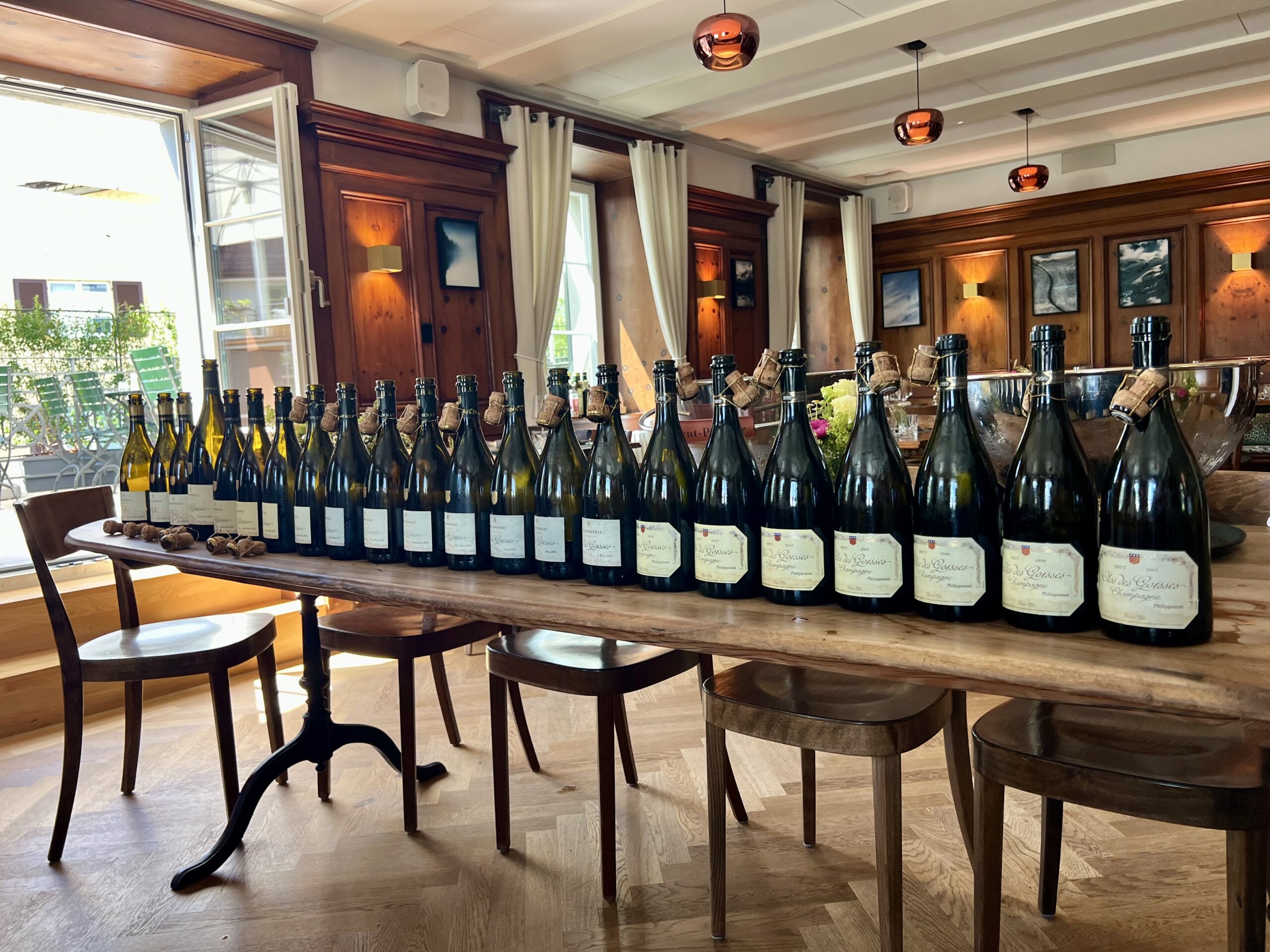
Author: Christian Raubach, WSET III, FWS, WSG Champagne Master
June 2026