Whether you like it or not, in Swiss quality wine, all roads lead to Gantenbein. They were the first Swiss high quality wine with international recognition. Firsts will always be firsts, a crown that can not be taken away. Neil Armstrong, Charles Lindberg and Reinhold Messner are in that category. So that is why, I always approach this estate with special attention. As so often, beginnings were humble and in a time where no-one in Switzerland was interested to make benchmark wine. Daniel and Martha Gantenbein established the domaine in 1982, taking over vineyards from Martha’s family in Fläsch/Graubünden and steadily transforming what was once a modest local operation. From the beginning, their philosophy centered uncompromisingly on the vineyard: Burgundian Pinot Noir clones were planted, yields were kept low, and every detail from pruning to harvest was managed with meticulous precision. Today the estate remains small – around 6 hectares in total – devoted primarily to Pinot Noir with smaller parcels of Chardonnay and a tiny amount of Riesling.
Gantenbein’s rise has also pushed other vignerons to make high quality wines in the Bündner Herrschaft, which is now widely regarded as Switzerland’s most compelling wine region. Valais and Vaud, our largest wine regions, remain entangled in past, still producing too much sub-standard aperitif wines that struggle to find consumers (Bundesrat Delamuraz who usually drank half the production by himself is no longer with us… LOL). Instead of improving their game, just as I am writing this, they went to Bern and ask for new Government subsidies/protection, demanding that every Swiss importer of foreign wine, also has to sell Swiss wine. Ridiculous – shame on them!
Martha and Daniel have explained over this terrific lunch how long their journey was and how sparse money and fame was throughout it. They had to replant the entire vineyard with different clones and higher density. Lots of investments had to be made and carefully timed to not overstretch the budgets. Luckily they both had good friends in Burgundy and beyond and we able to ask for advice, experiment, compare. They are also passionate Burgundy drinkers, including the very high end. This helps – knowing there the peak is makes you kicking the tires harder, searching for the next idea to push upwards. I remember a visit to Nicolas Groffier in Morey and saw his cellar full of wines from his competitors. I asked him, are you not worried your visitors think that you don’t drink you own wine? Not at all he mentioned, I need to know where the benchmark is and how I measure up against it.
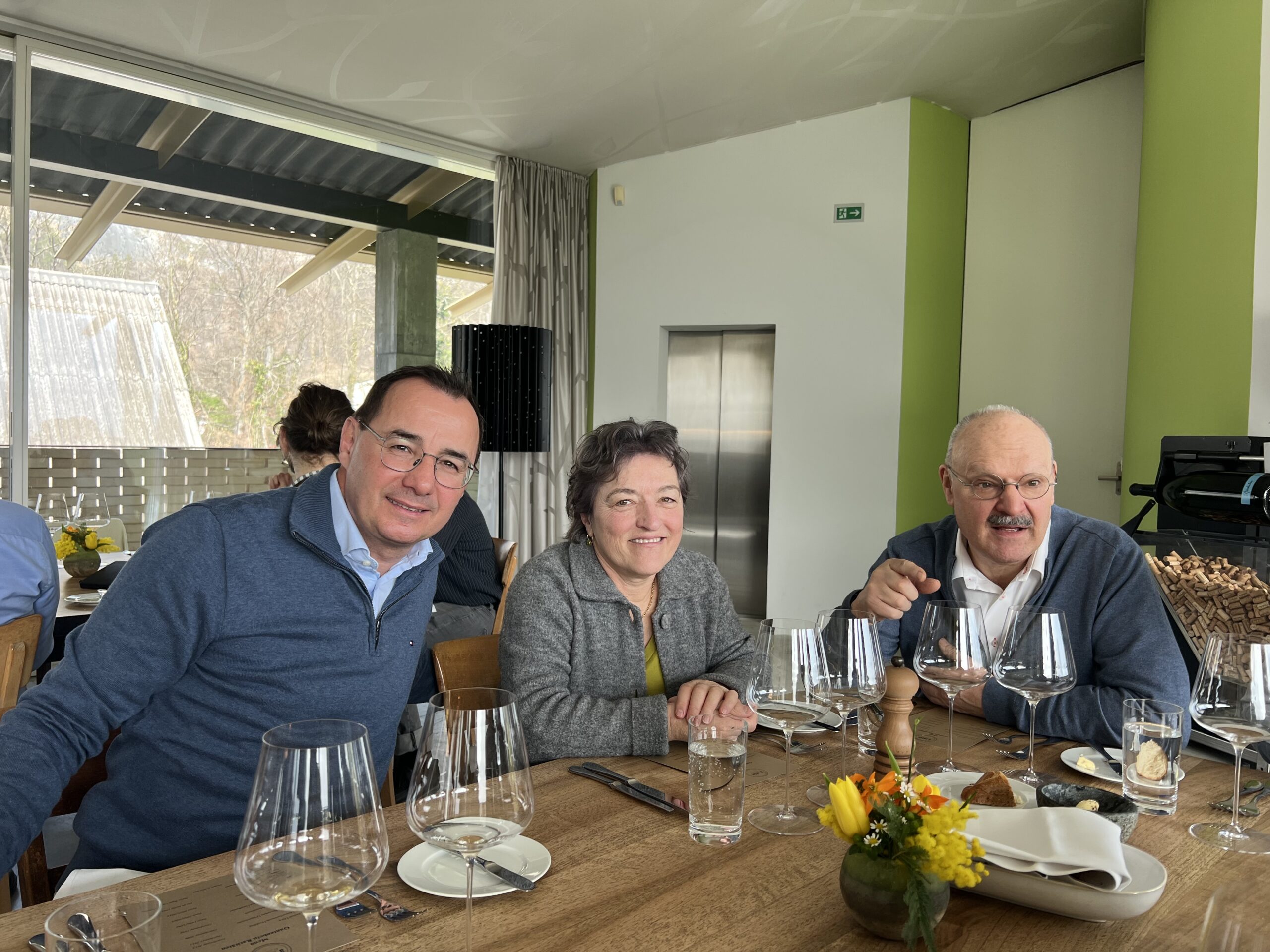
Martha and Daniel Gantenbein (left)
Leading critics have consistently praised the wines for their precision and Burgundian elegance. International reviewers frequently highlight the estate’s Pinot Noir for its depth, silky tannins and mineral structure, while the Chardonnay – aged in a significant proportion of new oak yet retaining remarkable freshness – has developed a particularly devoted following among collectors. The consensus among critics is that Gantenbein represents the pinnacle of Swiss winemaking: a domaine whose meticulous vineyard work, restrained cellar techniques and tiny production combine to create wines that stand comfortably among the finest expressions of Pinot Noir and Chardonnay produced anywhere outside Burgundy.
Tasting Notes
Aperitif
2020 Gantenbein Riesling trocken, 92 Points
A fresh and lifted nose showing citrus peel and delicate white flowers. The palate is light on its feet, the bright fruit character combining neatly with a stony mineral thread. The acidity is well judged and gives good shape through the mid-palate, ensuring the wine avoids any sense of thinness. Not the most complex example of the variety, but well balanced and harmonious. A sound and attractive Riesling.
Chardonnay
2015 Gantenbein Chardonnay, 95 Points
A very attractive nose, combining citrus fruit with discreetly integrated oak. There is a reductive edge which lends energy, suggesting a style not unlike some modern Chassagne producers like Paul Pillot. Generous yet controlled on the palate, the fruit has excellent clarity and the oak remains well judged. The balance between richness and freshness is particularly successful here. My favourite among the Chardonnays tasted today.
2011 Gantenbein Chardonnay, 92 Points
Noticeably riper than the 2015 beside it. The nose shows notes of bruised apple and almond, suggesting a slightly more advanced stage of development. With air the wine freshens appreciably, revealing better definition and a more lifted aromatic profile. Pleasant rather than profound but holding together respectably.
2006 Gantenbein Chardonnay, 92 Points
Fully mature aromatically with ripe apple, apricot and almond notes alongside clear tertiary development. The palate shows yellow fruit and a rounded texture. As Martha Gantenbein explained, earlier vintages were harvested later and saw a higher proportion of new oak while the vines themselves were younger. The evolution toward greater precision in more recent vintages is therefore evident.
1999 Gantenbein Chardonnay, 94 Points
Deep golden in colour but still very much alive. The bouquet is complex and mature with tarte tatin, mushroom and caramelised orchard fruit. Importantly there is no oxidative character. The palate retains surprising energy and balance. An idiosyncratic and compelling mature Chardonnay that has aged remarkably well. 94+
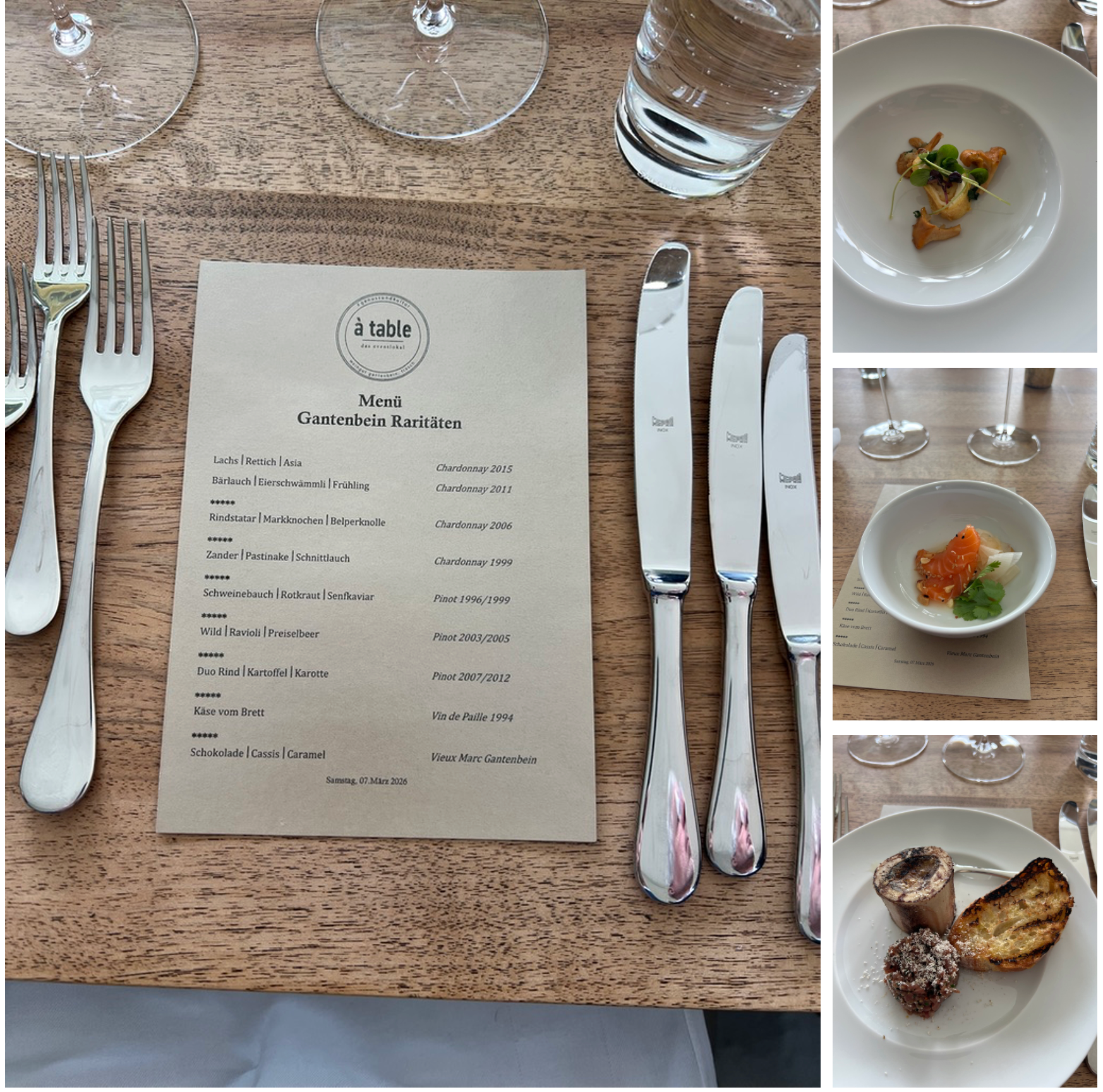 Christoph & Romina Ettisberger from Genuss und Kultur GmbH created a wonderful menue at Gantenbein’s Restaurant à Table which sits on top of the winery and can be rented for events.
Pinot Noir
1996 Gantenbein Pinot Noir, 95 Points
Bottled in the “Schlegel” format as we know it from German Riesling. Pale amber at the rim but very expressive aromatically. Strawberry compote, cinnamon spice and gentle savoury notes emerge from the glass, like a Rayas with more acidity. Made entirely from Swiss clones in a cool and challenging vintage, harvested at modest ripeness. The palate is lighter in body yet vibrant, with silky tannins and excellent acidity keeping everything fresh. In superb condition today.
1999 Gantenbein Pinot Noir, 92 Points
Also produced entirely from Swiss clones. Riper and softer than the 1996, with less structural tension. The nose shows clear tertiary development -mushroom, earth and forest floor. The palate is rounded and fully mature, the colour slightly cloudy. Probably just past its peak though still interesting.
2003 Gantenbein Pinot Noir, 94+ Points
An impressive achievement in a famously hot year. The grapes were picked very early – around the 1st of September – after consultation with their close friend Paul Draper (the Californian legend of Ridge winery), resulting in a wine of admirable freshness. Bright red fruit and earthy spice dominate the bouquet. The palate is precise and energetic, finishing with a firm tannic grip reminiscent of a Corton-style structure.
2005 Gantenbein Pinot Noir, 95 Points
Initially reserved, needing considerable aeration to reveal its full personality. Once open, darker fruit and earthy nuances emerge. Structurally this recalls the Burgundian 2005s with its firm backbone and notable concentration. A complete wine with significant ageing potential. A short decant recommended.
2007 Gantenbein Pinot Noir, 93 Points
Still produced from Swiss clones at this stage. The nose offers gingerbread and bakery notes alongside ripe red fruit. Broader and softer than the 2005, with more immediate generosity. As Martha Gantenbein noted, 2007 was an uncomplicated vintage in the Bündner Herrschaft, quite unlike Burgundy. Attractive but perhaps lacking a little structural grip.
2012 Gantenbein Pinot Noir, 96 Points
The standout of the tasting. A wonderfully expressive bouquet combining red fruits, autumn leaves, black tea and spice, complex and airly like a Vosne-Romanée. The palate is poised and beautifully balanced, light on its feet yet persistent. Silky tannins and fine acidity complete a wine of real elegance and charm.
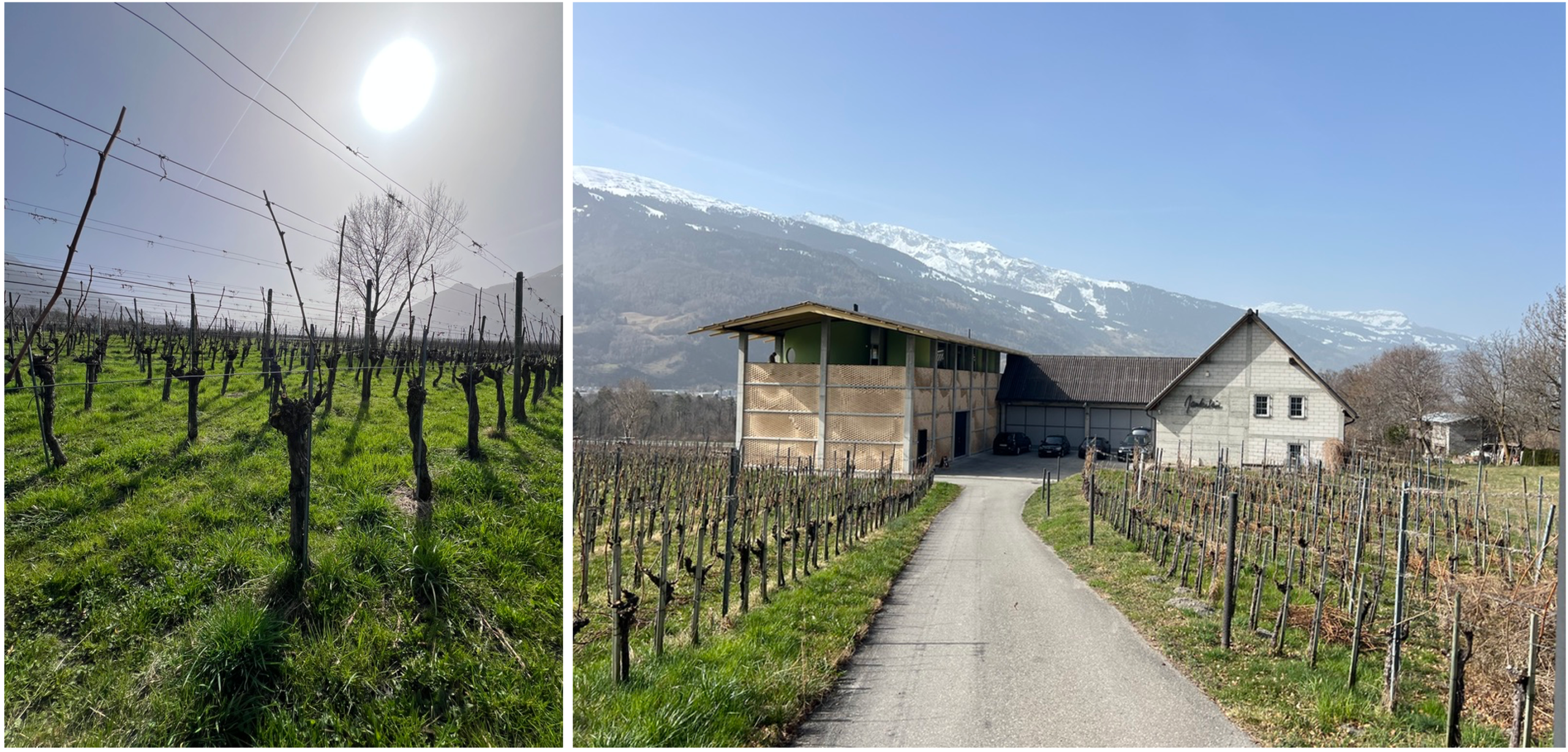
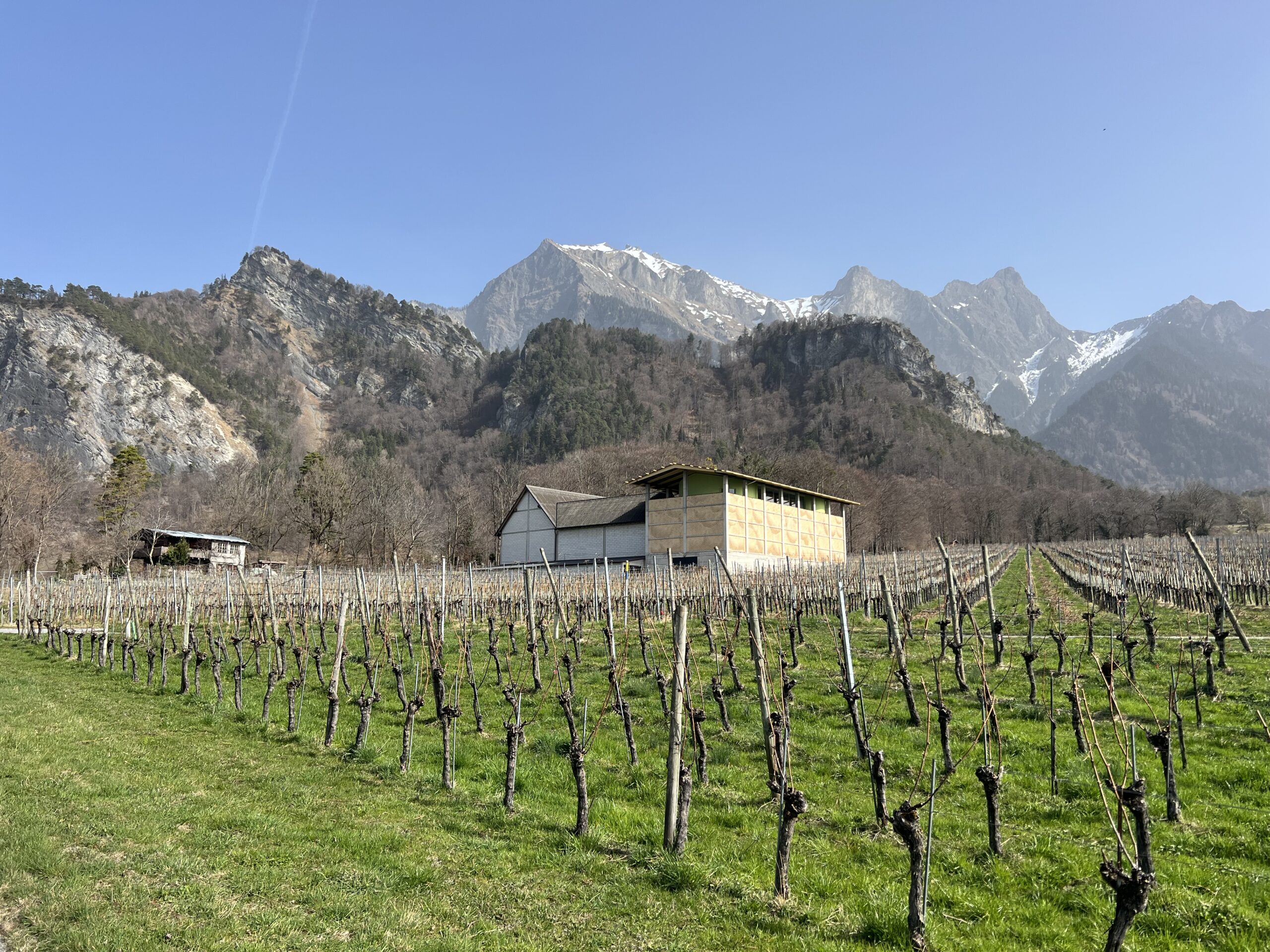
Vineyard and entrance to the winery
Vin de Paille (dessert)
1994 Gantenbein Pinot Noir Vin de Paille, 95 Points
A rare curiosity from the early years of the estate, produced from declassified grapes and never commercially released. The nose is complex with dried fruit, strawberry jam and exotic spice, yet entirely clean with no oxidative character. The palate carries substantial richness—around 15–16% alcohol—but is kept remarkably fresh by vibrant acidity (the Pinot signature). A fascinating wine and a reminder that acidity remains the foundation of all great sweet wines. Production has since ceased, as the Burgundian clones now planted do not dry as easily as the older Swiss selections.
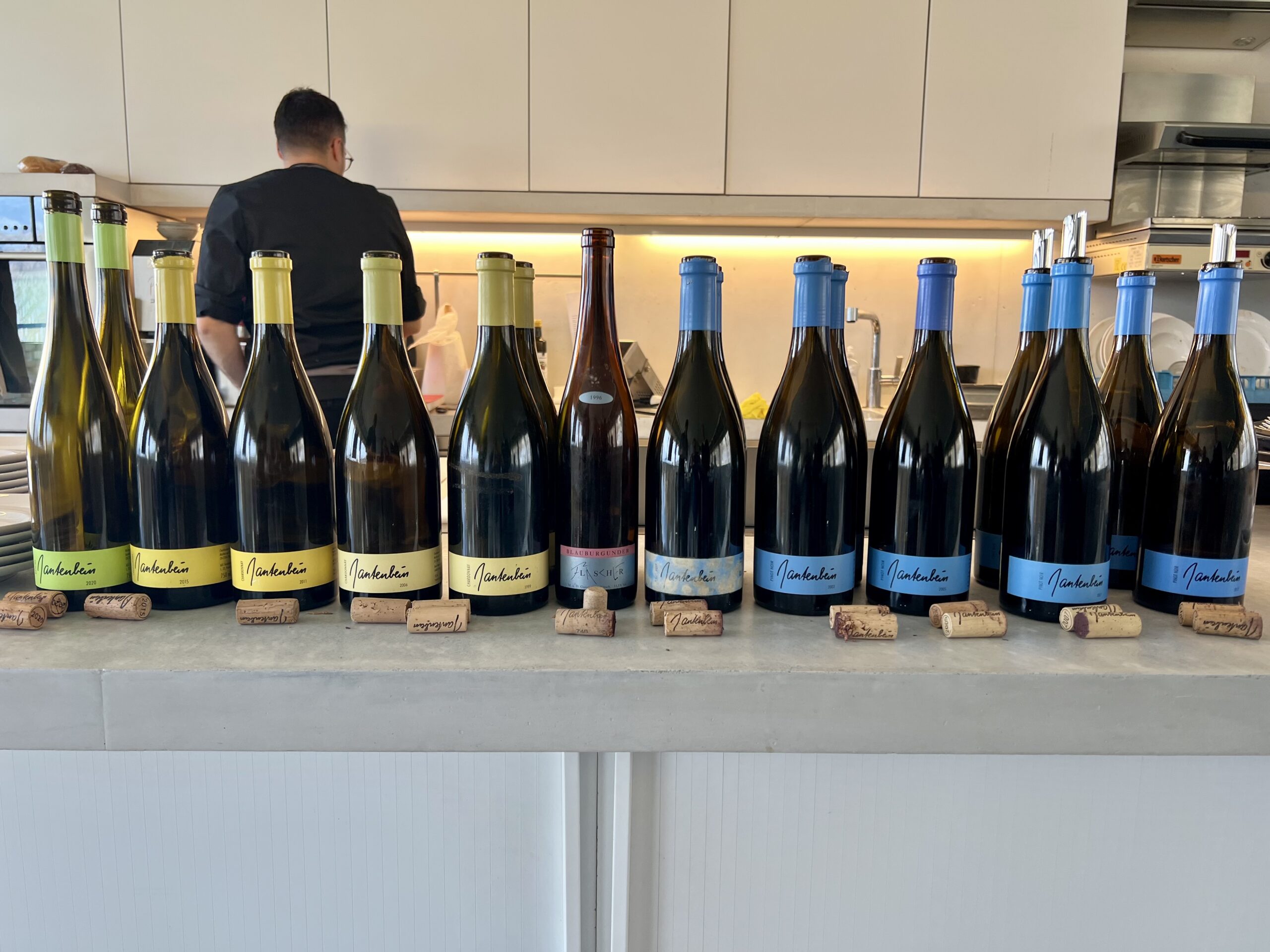
The line-up of the lunch stretching back 30 years of winemaking
Author: Christian Raubach, WSET III, FWS, WSG Champagne Master
March 2025